
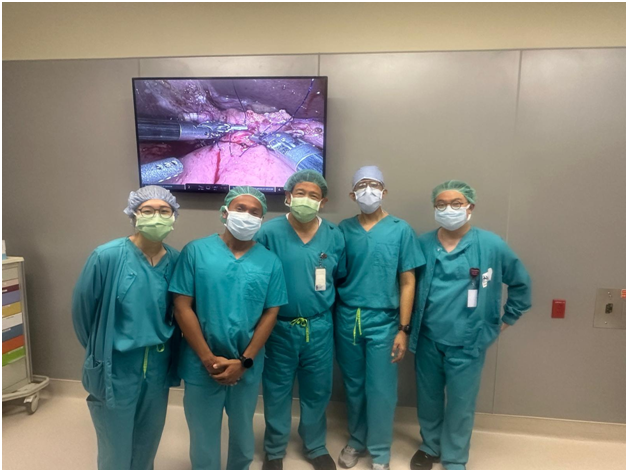
Dr. Sucandy Hosted Joint Symposium of International Laparoscopic Liver Society -SAGES during 2026 Annual Symposium in Tampa Florida
Society of Gastrointestinal and Endoscopic Surgeons (SAGES) is the largest multispecialty minimally invasive surgical society in the World with almost 8000 active members. The society was founded more than 20 years ago fostering development of minimally invasive surgery technique including endoscopic surgery, laparoscopic surgery and now robotics. At its early days, SAGES was instrumental in the development and adoption of laparoscopic cholecystectomy, hernia surgery, foregut surgery, bariatric and colorectal surgery. As minimally invasive technique diffuses into almost every subspecialties including hepatobiliary and pancreatic surgery, SAGES increases its presence and role to the world of hepatobiliary surgeons. Despite being late adopters in laparoscopic surgery, liver surgeons gradually and carefully apply laparoscopic technique in minor and major hepatectomy to remove liver tumors and to procure liver graft in living donor liver transplantation. Today, laparoscopic liver surgery is considered the goldstandard for minor hepatectomy and recommended technique in major hepatectomy in centers with expertise.
Acknowledging the need for training and safe adoption of this technically difficult liver operation, International Laparoscopic Liver Society (ILLS) was founded in Paris and has been growing ever since with almost 1000 active members. ILLS also now includes robotic liver surgery to further foster adoption of minimally invasive technique for highly demanding/complex resections where laparoscopic technique is deemed unfeasible. This includes major hepatic lobectomy, extended hepatectomy, meso-central hepatectomy and liver resection with concomitant biliary and vascular reconstructions. Expert centers now are transitioning from laparoscopic to robotic liver surgery to be able to offer better and safer operation for difficult tumors. Robotic perihilar cholangiocarcinoma or Klatskin’s tumor is an example of this transition. Dr. Sucandy and his team have been instrumental in this transition and in education for surgeons worldwide through robotic training courses under ILLS, live demonstration robotic liver surgery, robotic proctoring in liver and pancreas surgery, multicenter collaborative robotic studies, and many others.
In 2026, ILLS held a joint symposium with SAGES in Tampa offering a specific educational session covering technique of liver transection, exposure method for deep seated liver tumors, bleeding control during liver surgery, vascular management, learning curve for robotic hepatectomy. Dr Sucandy had the opportunity to design and chair this joint symposium with his colleague Dr. Hop Tran Cao from MD Anderson Cancer Center and Prof. Ho Seong Han from Seoul National University Korea. Prof Han was indeed a pioneer of laparoscopic liver surgery and a former President of ILLS. Many hepatobiliary surgeons were present to share their skills, knowledge and surgical techniques. At the same week, Dr. Sucandy also hosted a robotic live case observation for visiting surgeons coming from Asia and South America to observe Robotic Pancreaticoduodenectomy/Whipple operation for pancreatic head cancer and Robotic liver surgeries performed by Dr. Sucandy. The week was filled with both educational and clinical training for hepatobiliary-pancreatic surgeons attending the SAGES 2026.
