
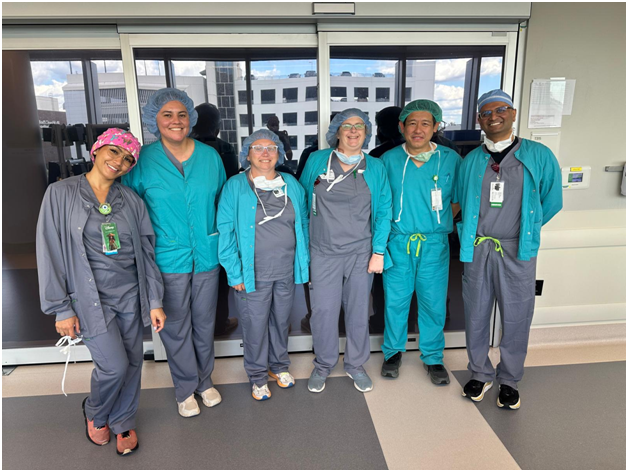
Dr. Sucandy Hosted Robotic Live Case Observations for Robotic Liver and Whipple Operations for Chief of Surgical Oncology and Hepatobiliary Surgery
As a leading surgeon in robotic liver and robotic pancreas surgery, Prof. Dr Sucandy often hosts robotic live case observations for visiting surgeons trying to adopt and learn the robotic techniques in pancreas and liver surgery. Dr. Satyananda – the Chief of Surgical Oncology of University of Missouri with his partner and OR team came to Tampa to participate in a robotic Whipple case observation for pancreatic head tumor performed by Dr Sucandy. In this complex operation, head of pancreas, lower end of bile duct, and duodenum was resected enbloc to remove tumor within the head of pancreas causing a biliary obstruction. The operation was performed with robotic surgery and was completed without complications within 4 hours. Details of robotic dissection techniques and biliopancreatic reconstructions were pointed out in detail as the operation moved forward. The operating room team from University of Missouri also had the opportunity to learn from Dr Sucandy’s team in term of perioperative preparation, instrumentations, intraoperative emergency preparedness, postoperative patient managements, anesthesia fluid administration, and overall team dynamics. Beside an expert in robotic liver surgery, Dr Sucandy also is an expert in robotic pancreatic surgery, having performed more than 100 robotic Whipple operations. In the past 10 years, Dr Sucandy had performed more than 1000 (one thousand) robotic liver and pancreatic surgeries.
A second team from Cleveland Clinic Florida also came to participate in a robotic live case observation in Tampa. Dr Conrad Simpfendorfer visited Dr Sucandy and his team to observe robotic liver resection for type 4 perihilar cholangiocarcinoma. Despite of the technical complexity, this operation was completed with robotic method securing negative resections margins. Difficut biliary/vascular resection and delicate anastomosis were the ultimate applications and value of using robotic surgery. The patient recovered uneventfully after the 8 hour operation and he was discharged home after 6 days of hospitalization. At 3 months follow up, he was doing well without evidence of tumor recurrence of postoperative and biochemical surveillance. The patient was followed by his medical oncologist at Florida Cancer Specialist in Largo Florida.
In the past decade, Dr. Sucandy and his team had hosted more than 30 teams from around the world to observe robotic liver and pancreas surgery for various indications and circumstances. Surgeons from Ukraine, Brazil, Taiwan, Italy, Russia, Bulgaria, Indonesia, Philippines, Japan, Peru, Mexico, United Kingdom, Spain, and many others had participated in robotic live observations in Tampa with Dr. Sucandy, spending time from days to weeks.
